

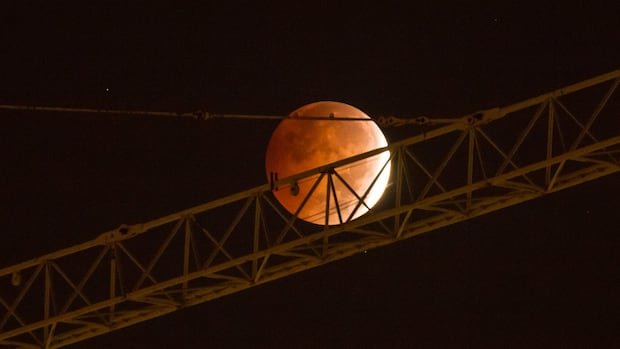

On the night of August 27-28, a deep partial lunar eclipse will be visible across Canada. This event follows the total solar eclipse seen in Iceland, Spain, and a small part of Portugal about two weeks ago.
Lunar eclipses occur when the moon passes through Earth’s shadow, known as the umbra. Before reaching the umbra, it first goes through the penumbra, which is dimmer and harder to see with the naked eye.
Most regions in Canada will witness the entire eclipse, while Western Canada will observe the partial eclipse as the moon rises.
Unlike solar eclipses that require protective eyewear, lunar eclipses can be viewed without any special equipment. The lunar eclipse unfolds over hours, offering a prolonged viewing experience compared to the swift nature of solar eclipses.
The eclipse will commence as the moon enters Earth’s penumbra around 10 p.m. ET. The visible phase of the eclipse will start at 10:33 p.m. ET on August 27 and conclude at 1:52 a.m. on August 28, with the deepest darkness expected at 12:13 a.m.
This astronomical event is one of many occurring this month. Elaina Hyde from York University’s astronomy department mentions the series of celestial events in August, including the partial solar eclipse on August 12, the Perseids meteor shower, and the Jupiter-Mercury conjunction.
While the eclipse won’t result in a “blood moon,” it may still appear red in certain areas of Canada. Lunar eclipses offer a spectacle that can be enjoyed with the naked eye, but binoculars, a small telescope, or a smartphone with a good night mode can enhance the viewing experience for capturing images.