

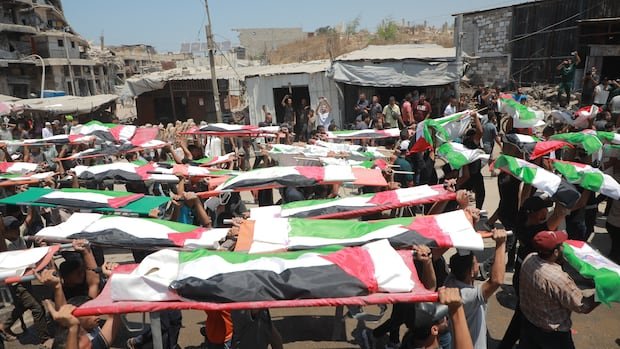

In Gaza City, amidst the wreckage from an Israeli airstrike that occurred at the onset of the conflict, over 100 orange stretchers adorned with Palestinian flags were laid out on Tuesday morning. Some of these flags, smaller in size, signified the remains of children. Among the rubble, there were photos placed on some of the makeshift shrouds, while others were decorated with flower petals. It took nearly three years to recover these remains, now reduced to bones, teeth, and shreds of clothing.
These remains belonged to 112 individuals from the Abu Sharia and Hasayna families, members of the same extended family, who lost their lives in the Israeli airstrike on November 23, 2023, in their residential neighborhood.
Hundreds of mourners, including surviving family members, gathered on Tuesday morning to offer prayers for the deceased as they were laid to rest at the nearby Baptist cemetery.
The families have been searching for their loved ones alongside Gaza’s Civil Defence for years, but the process has been hindered by the lack of heavy machinery in the area. Mahmoud Hasayneh, present to bury his brothers, expressed the reopening of old wounds for the family, stating, “Now we will start a new broken heart with this mission and all our family is crying.”
Last month, Youssef Abu Sharia, 23, awaited anxiously at the site of the strike as an excavator slowly worked through debris and metal in the hopes of uncovering any human remains buried beneath. Damage to some heavy machinery in the area due to Israeli strikes has impeded the retrieval efforts. Abu Sharia, who lost multiple family members in the November attack, emphasized the prolonged search for their remains due to the equipment shortage.
At the funeral, Abu Sharia mentioned a sense of relief at finally being able to lay their loved ones to rest after three years of waiting, alongside feelings of frustration and sorrow over “a wound that has opened again.”
Tayseer Abu Sharia, another relative present at the funeral, shared the challenges faced over the past few years while waiting for assistance from the Civil Defence. Eventually, they resorted to digging through rubble manually. Calls have been made by the Civil Defence and human rights groups for Israel to permit the entry of heavy equipment into Gaza to aid in the recovery efforts.
According to Zaher al-Waheidi, head of the health ministry’s records department, at least 7,400 individuals are still trapped under debris in Gaza, with the actual number likely much higher due to entire families being wiped out in single strikes.
Mahmoud Basal, the Civil Defence spokesperson, urged the international community to intervene and provide necessary machinery for the excavation efforts in Gaza, emphasizing the lack of resources and tools faced by the teams.
The funeral on Tuesday marked a historic moment as mourners bid farewell to 112 individuals from the Abu Sharia and Hasayneh families. The ceremony commenced with a prayer at the strike site over the flag-covered remains, followed by a procession to the cemetery where onlookers tossed flower petals.
As the families laid their loved ones to rest, Youssef Abu Sharia and his surviving relatives reflected on the thousands still missing, wondering, “Where did they go?”