

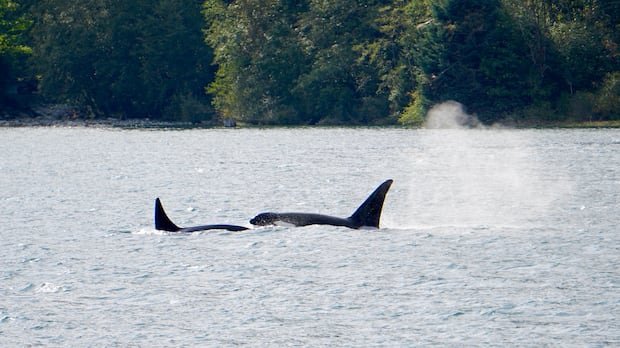

John Ford, a veteran researcher at Fisheries and Oceans Canada, has devoted over four decades to studying the distinctive calls of orcas along the West Coast. Thanks to a newly launched online database, his extensive collection of recordings is now accessible to the public, raising optimism for aiding in the detection and safeguarding of these marine creatures from potential vessel collisions.
Ford, who kickstarted his orca sound research during his graduate studies in the late 1970s, uncovered a fascinating communication system among different orca subgroups. These marine mammals employ unique sets of calls to identify and bond with their family members across vast distances while on the hunt or foraging.
The calls, categorized into distinct subgroups ranging from smaller pods to larger populations like the northern and southern resident orcas and Bigg’s, are remarkably consistent over time, passed down through generations via vocal learning. Ford highlighted the stability of these calls by referencing recordings from the 1950s that closely resemble today’s orca vocalizations.
Decades later, Simon Fraser University’s HALLO project has introduced an online call catalogue featuring sounds from various orca populations, including Bigg’s, northern and southern residents. This database enables users to sort calls by clan and pod, empowering individuals monitoring whale sounds through coast-spanning hydrophone networks to pinpoint specific populations.
SFU environmental science professor Ruth Joy, instrumental in bringing the catalogue to fruition, emphasized the potential for citizen scientists to leverage this tool in safeguarding orcas from ship collisions, a significant threat to the critically endangered southern resident orcas, currently dwindling to just 75 individuals.
While the current catalogue lacks individual whale identification within family groups and excludes offshore orcas, its significance in aiding conservation efforts cannot be understated. Ford expressed his ambition for the catalogue to expand to encompass more orca populations globally, encouraging researchers worldwide to compile similar databases for their local orca communities.
In the ongoing quest to protect these majestic creatures, the accessibility of this invaluable resource marks a pivotal moment in collaborative efforts towards orca conservation.