

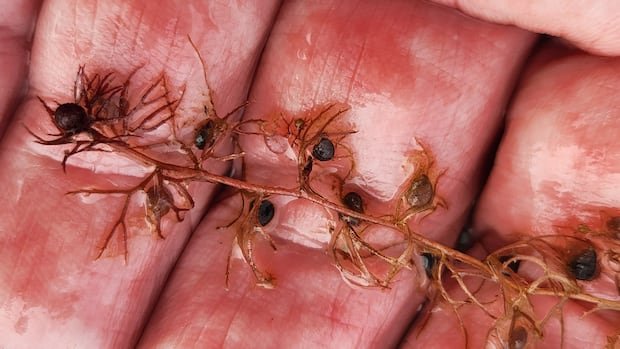

Plant enthusiast Klaus Koehler made an interesting discovery while exploring Sylvia Grinnell Territorial Park near Iqaluit in July. He stumbled upon a plant species rarely seen in the Arctic, which he believes could have implications for the spread of invasive species in Northern environments as temperatures rise.
Koehler reached into a pond and retrieved a brownish weed-like plant known as bladderwort. While this plant may appear unremarkable to the untrained eye, Koehler recognized its unique characteristics. The carnivorous plant is adorned with small black bladders containing partially digested flies, a feature not commonly found in Arctic regions.
The presence of this insect-eating species in the Arctic is unusual, with the only other documented instance dating back to 2012 when scientists discovered bladderwort near Kimmirut, approximately 120 kilometers southwest of Iqaluit. During their Arctic expeditions, the research team identified over 30 new plant species in the region.
Koehler speculates that the emergence of bladderwort in Iqaluit may signal a changing climate. While the Arctic has historically harbored few invasive species due to its harsh conditions, the warming climate is creating a more favorable environment for plants that traditionally do not thrive in the region.
This shift in vegetation patterns is expected to alter the Arctic ecosystem significantly. As summers become warmer and winters milder, plant life in the region is extending its range. Concerns are raised about the potential introduction of invasive species through various means such as birds, ships, and human activity.
Paul Sokoloff, a senior research assistant at Ottawa’s Museum of Nature, shares these concerns, drawing on past experiences where invasive species have disrupted ecosystems in other parts of Canada. While the discovery of bladderwort in Iqaluit may not pose an immediate threat, the potential influx of other non-native plants could have detrimental effects on the Arctic’s biodiversity.
Research indicates that thousands of plant species have the capacity to encroach upon Arctic territories, outcompeting native flora. Scientists continue to study the implications of climate change on plant migration patterns and its impact on Arctic ecosystems.
Koehler plans to collect a sample of the bladderwort found in Iqaluit for further analysis at the Museum of Nature. This initiative aims to enhance scientific understanding of the plant’s northward expansion and its ecological implications.