

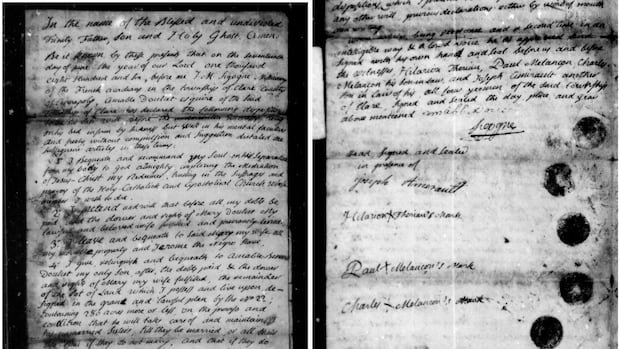

Hilarion Thériault, a 71-year-old Acadian, defied the norm by preparing a will during the 19th century, a rare occurrence among his community. This deviation stemmed from the historical context where many Acadians had limited assets to pass down due to the aftermath of the Acadian deportation, which resulted in the loss of their properties. Moreover, until the 1780s, Roman Catholics in the region were barred from property ownership, leading to challenges in obtaining land titles despite residing and working on the land for years.
Colby Gaudet, a post-doctoral researcher at Dalhousie University, delved into Thériault’s will and 23 other wills from the Acadian enclave of Clare, N.S., to gain insights into how families navigated the legal and religious protocols surrounding death. These wills reflect a blend of resistance and compliance, as Acadians adhered to established Anglophone property regulations while asserting their Roman Catholic identity.
Thériault’s will stipulated the settlement of debts, sought reparations for any injustices, and aimed to bring peace to his family. Maurice Basque, a historian at l’Institut d’études acadiennes at the Université de Moncton, highlighted the significance of these wills within the context of Acadians facing social ostracism.
Following the 1755 deportation, where Acadians were expelled for not aligning with the British Crown, their lands were seized by the Crown and redistributed to settlers from New England, marking a deliberate effort to displace the Acadian population. Although some Acadians eventually returned, they encountered systemic barriers, including oath tests designed to undermine their Catholic beliefs, limiting their access to positions of influence.
Gaudet noted the language barrier faced by Acadians when engaging with the predominantly Anglo-Protestant judiciary system, with all county judges overseeing the wills being of that background. These wills, drafted by the French priest Jean-Mandé Sigogne, served as a crucial link between the Acadian families and the legal system.
The wills examined by Gaudet, often left by community leaders like Thériault, underscored the strong influence of the Catholic Church in their daily lives. Despite societal stigmatization, these wills incorporated distinct Catholic elements, such as references to the Virgin Mary and saints, distinguishing them from Protestant wills that typically invoked a more generic religious tone.
Moreover, the study of these wills shed light on the interactions between Black individuals and Acadians in Clare. Notably, Amable Doucet’s will, which bequeathed a Black slave named Jerome to his wife, and Étienne Thibodeau’s will, which involved a Black man from New York as a witness, revealed unique racial dynamics within the community.
Overall, the examination of these historical wills provides valuable insights into the legal, religious, and social complexities faced by the Acadian community during a period of profound upheaval and resilience.