

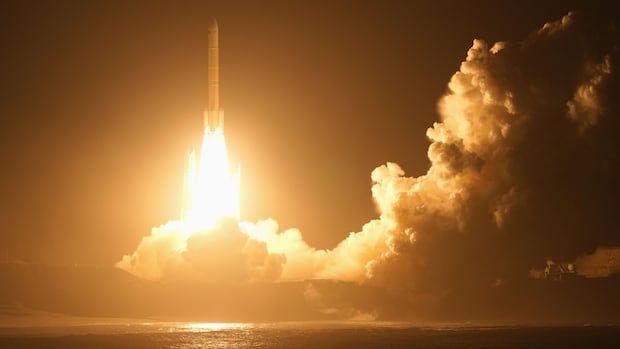

A Japanese spacecraft was launched towards Mars on Tuesday, embarking on a groundbreaking mission to investigate its enigmatic moons and retrieve samples.
In a collaborative effort, five global space agencies have united for this five-year endeavor, which aims to deploy a robotic lander and rover on Phobos, the larger and nearer of Mars’s two diminutive moons.
The Japan Aerospace Exploration Agency (JAXA), spearheading this ambitious sampling mission, successfully lifted off the spacecraft shortly before dawn from the main spaceport located on Tanegashima Island. An hour later, officials confirmed success when the spacecraft separated from the rocket’s upper stage as intended. The flight controllers celebrated with applause, standing up to shake hands and hug each other.
While NASA has successfully landed nine spacecraft on Mars over the last fifty years and China achieved a successful landing in 2021, Phobos and its companion Deimos remain unexplored. Furthermore, no mission has retrieved samples from Mars or its moons.
Should the mission succeed, samples of dust, soil, and rocks from Phobos are expected to reach Earth by 2031.
“There’s a surge of adrenaline, excitement, and awe,” commented NASA astrophysicist Tom Statler, who is participating in the project.
Japan holds a competitive advantage, having previously completed two asteroid sample return missions.

Staff from the Japan Aerospace Exploration Agency and others celebrate at the Tanegashima Space Centre after the successful launch and planned separation of a Japanese spacecraft aboard an H3 rocket on Tuesday. (Naoki Hiraoka/Kyodo News/The Associated Press)
Phobos: A small, irregular moon
Phobos is a potato-shaped, irregular rock measuring approximately 22 kilometers across. Studying its material could provide insights into the formation of Mars’s moons and potentially other moons throughout the universe.
Known as MMX, or Martian Moons Exploration, the mission, which costs $812 million ($578 million US), features a substantial five-ton spacecraft set to arrive at Mars by late next summer. It will align with Phobos’s tight orbit around Mars before releasing the French-German rover named Idefix, inspired by the white terrier from the Asterix comics.
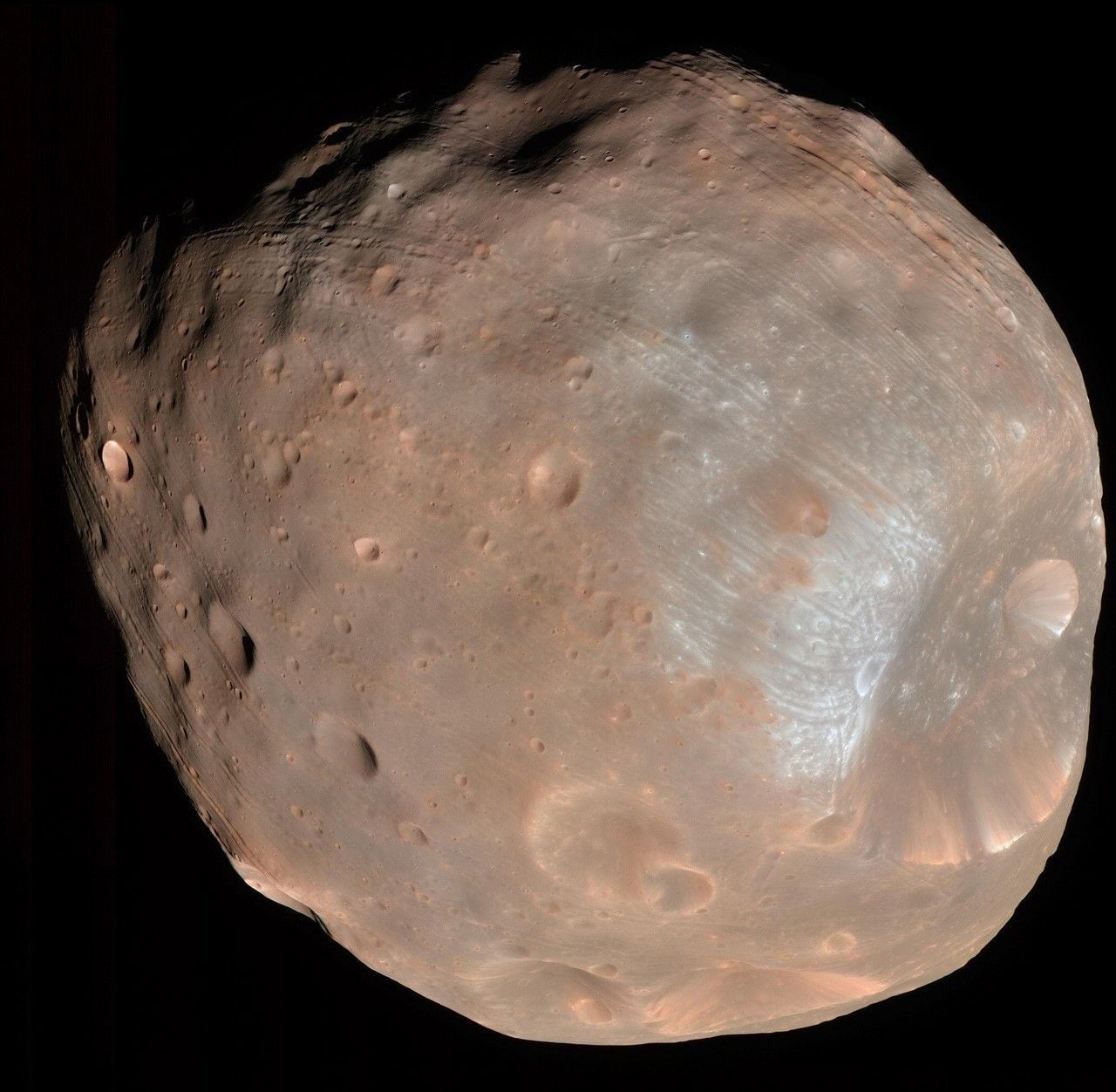
This image captured by NASA’s Mars Reconnaissance Orbiter shows Phobos, one of Mars’s moons, taken on March 23, 2008. No spacecraft has previously visited this moon. (NASA/The Associated Press)
The Idefix rover, comparable in size to a microwave oven, will land on Phobos autonomously, bouncing for several minutes before settling due to the moon’s extremely low gravity.
Post-landing operations for Idefix
The four-wheeled rover is engineered to right itself if it lands on its side. However, challenges may arise if it sinks into loose soil or becomes trapped between rocks, according to Julien Baroukh from the French Space Agency. Once the rover’s solar panels deploy, it will be unable to right itself, which is why it is designed to move at a very slow pace of just one millimeter per second (0.04 inches per second).
Baroukh referred to Idefix as a “safety scout,” as it will explore Phobos for 100 days. Japanese flight controllers aim to identify suitable landing sites for the main lander, a four-legged stationary unit, to avoid soft soil and rocky areas when it descends to collect samples in late 2028 or 2029.
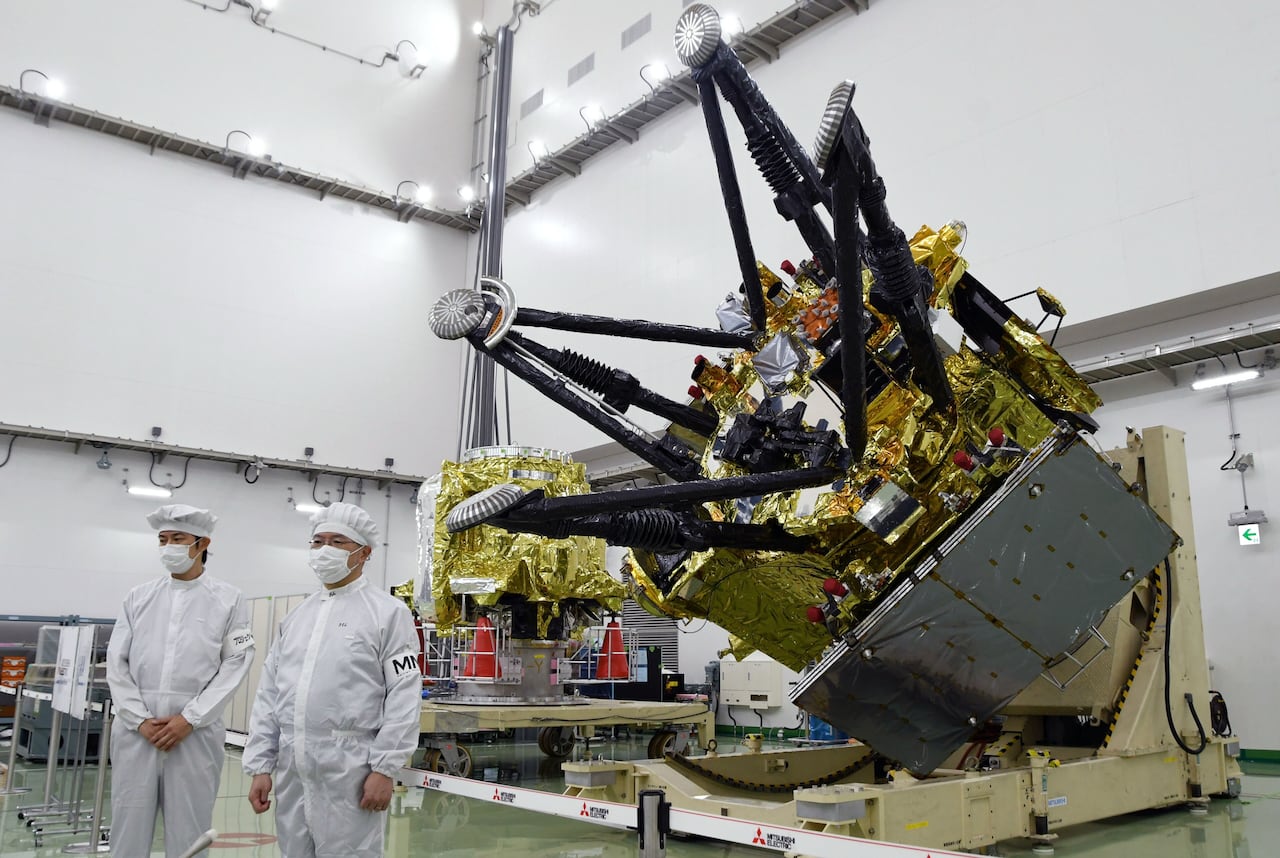
The Japan Aerospace Exploration Agency showcases a spacecraft for its Martian Moons eXploration mission at the Tanegashima Space Center in Minamitane, Japan, on Aug. 13, 2026. (Yuika Kawazoe/Kyodo News/The Associated Press)
The lander is scheduled to spend only two hours on Phobos, during which it will drill and vacuum up at least 10 grams (one-third of an ounce) of material before launching back into space. It will then conduct a series of flybys of Deimos prior to exiting the Martian vicinity in 2030 and returning to Earth for a sample delivery in the Australian desert in 2031.
This mission presents significant risks, with debris scattered along the intended path.
The names of the moons evoke unease: Phobos translates to fear in Greek, while Deimos means dread. They are the twin offspring of Ares, the god of war (known as Mars in Roman mythology).
Research aims regarding the origins of Mars’s moons
Russia encountered failures in all three attempts to reach Phobos, along with various other Mars missions. In its previous Mars endeavor, Japan was unable to place a spacecraft in orbit around the planet. NASA, too, has faced setbacks in its quest to determine if life ever existed on Mars.
By investigating the moons of Mars, researchers aspire to uncover whether Phobos and Deimos resulted from a historic collision involving Mars and a space rock. Alternatively, the moons may be rogue asteroids captured by Mars’s gravitational pull.
In any case, scientists expect to discover signs of Mars on Phobos, making the samples a compelling two-for-one opportunity that could illuminate the processes of planetary and moon formation, and potentially unveil the ingredients for life.
The insights gained will inform future Mars missions, including those involving human exploration, as highlighted by NASA’s acting planetary science director, Lindsay Hays.
“This is a once-in-a-lifetime opportunity. We are part of the first sample return mission from the Martian system,” stated Markus Grebenstein, rover chief at the German Space Agency.
Japan is not the only country eager to seize the scientific opportunities presented by the Martian system’s rocks and soil. China intends to launch its own sample return mission to Mars in 2028, while NASA continues to deliberate on how to retrieve over 30 sample tubes collected by the Perseverance Mars rover, the latest champion in off-Earth exploration.
Japan and China may be in a close race to return samples from the Martian system, both targeting the year 2031.
Japan has allocated $350 million for this mission, with NASA contributing $122 million ($87 million US), the French Space Agency approximately $95 million ($68 million US), the German Space Agency around $79 million ($56 million US), and the European Space Agency about $24 million ($17 million US).