

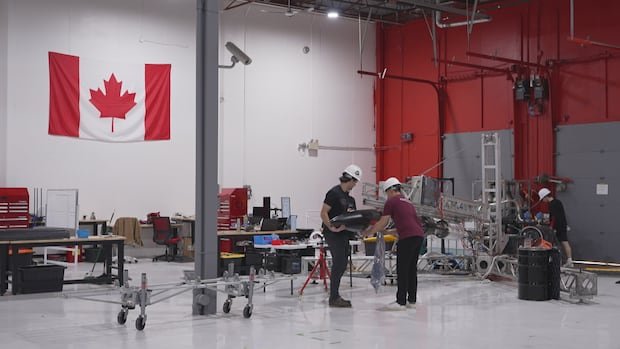

Canada, as the only G7 nation lacking its own launch capabilities, is striving to develop a Canadian-made rocket. Several Canadian companies are in a race to establish the country’s access to space, while there are concerns among some SpaceX clients that the company may reduce its orbital rides. The rocket companies face challenges due to high costs, tight deadlines, and shifting government priorities, complicating the journey to space.
Since Canada cannot launch rockets domestically, customers in the country rely on external providers, mainly American ones like SpaceX. These satellites are crucial for various purposes such as telecommunications, military applications like threat detection, and earth observation like wildfire monitoring, according to Marc Boucher, the founder of SpaceQ. The lack of control over launches poses a risk of foreign entities refusing to launch Canadian technology.
To address this issue, the Canadian government has recognized space as a vital sovereign capability and introduced legislation to authorize launches from Canadian soil. Recent funding initiatives include $8.3 million each for three Canadian companies working on rockets, with the aim of achieving light-lift rocket capabilities by 2028. NordSpace, one of the companies, faced an unsuccessful suborbital rocket test launch in 2025 but plans to make another attempt soon. Another participant, Reaction Dynamics, has been developing a unique engine design since 2017.
Canada Rocket Company, the newest entrant, is focused on constructing a medium-lift rocket powered by nine methalox-fuelled engines. The company has attracted private investment and is establishing a $30 million test facility in London, Ont., with a target to launch by 2032. Despite historical funding challenges, the increased financial support has bolstered optimism among industry players.
Meanwhile, SpaceX is planning to phase out its Falcon 9 rocket in favor of a larger vessel called Starship, raising concerns among satellite customers reliant on Falcon 9 launches. This transition could create opportunities for emerging rocket manufacturers. Canadian satellite communications company Kepler, for instance, has launched most of its satellites on Falcon 9. The potential reduction in Falcon 9 availability underscores the importance of having a Canadian rocket maker.
The Canadian rocket industry still faces hurdles and requires substantial investments to achieve regular launches. The long-term nature of the endeavor is emphasized by industry experts, who anticipate the need for continuous private and public funding to realize successful launches from Canada.