

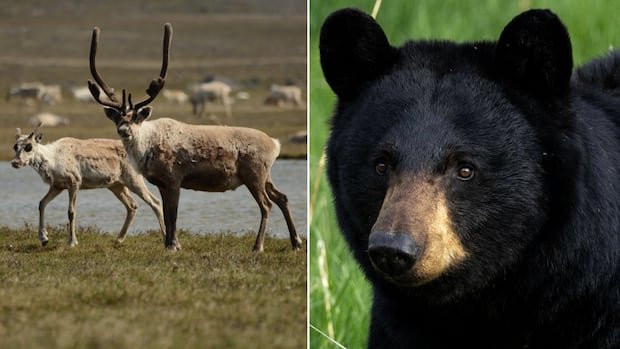

The Alberta government’s decision to allow hunters to utilize dogs in black bear hunting to support caribou conservation efforts has sparked controversy among wildlife biologists. This regulatory change, introduced last year by Forestry and Parks Minister Todd Loewen, received mixed reactions from wildlife advocates and hunters. The recent reinstatement of this practice has triggered public calls to revoke the hunt and a campaign in support of it.
According to this year’s Alberta Guide to Hunting Regulations, the use of dogs in black bear hunting aims to aid predator management in areas where caribou recovery is a concern. However, former caribou manager Dave Hervieux disputes the effectiveness of this strategy, stating that there is no scientific basis to suggest that hunting black bears with dogs would benefit caribou conservation efforts.
Hervieux highlights that in the wildlife management units where hunting black bears with dogs is allowed, many do not have caribou habitats. He emphasizes that historically, these areas have not supported caribou populations, casting doubt on the claimed conservation benefits of this hunting method.
While the government’s wolf cull initiative has proven effective in stabilizing caribou populations, Hervieux argues that targeting black bears for population control is not similarly justified. He points out that black bears have minimal impact on caribou calves in Alberta, unlike wolves, and stresses the importance of habitat conservation for true caribou recovery.
Echoing Hervieux’s concerns, University of Alberta ecology professor Mark Boyce dismisses the notion of using dogs in black bear hunting to protect caribou. Boyce’s research indicates that black bear predation on caribou is negligible in Alberta, making the likelihood of hunters targeting bears that pose a threat to caribou extremely low.
The province’s rationale for allowing dog-assisted black bear hunting revolves around providing sustainable hunting opportunities for Albertans, with caribou conservation being labeled as a secondary benefit. However, critics like Hervieux and Boyce were not consulted on this decision, raising questions about the scientific basis behind the regulatory change.
The controversy surrounding the use of dogs in black bear hunting highlights the ongoing debate between wildlife management strategies and conservation efforts in Alberta. While the province defends its approach as a means to support caribou recovery, critics argue that more comprehensive and scientifically grounded measures are needed to ensure the long-term survival of caribou populations in the region.