


What exactly is dark energy? Is there a multiverse? Are there additional forces beyond the four fundamental ones we currently understand?
These represent just a fraction of the unanswered questions in physics, yet these enigmas — along with the curiosity they evoke — serve as inspiration for particle physicist Asimina Arvanitaki.
Arvanitaki’s scientific journey has taken her from studying subatomic particles to exploring the farthest corners of the universe — and from her homeland of Greece to the Perimeter Institute for Theoretical Physics in Waterloo, Ontario, where she is currently employed. At a Perimeter Institute event on October 7, Arvanitaki engaged in a discussion with Ideas host Nahlah Ayed about her professional path, the essence of science, the influence of artificial intelligence, and more. Below is an excerpt from their dialogue.
Can you elaborate on the significance of curiosity in your love for science and your research?
One doesn’t pursue a career in science without being comfortable with constant confusion.
I grew up in Greece, and upon reaching the end of high school, you are compelled to select a major — which is quite a daunting task since most people have no idea what they wish to pursue. In my case, I was torn between science and engineering. I enjoyed mathematics, physics, chemistry — all of it. I discovered that my interest lay more in exploring the “why” behind phenomena rather than merely focusing on how to make things operate.
This realization led me to study physics. Eventually, I gravitated towards particle physics, which involves the fundamental components of matter. While it pertains to the tiniest elements, understanding them requires a perspective on the entire cosmos to see how everything fits together. Thus, it is a vast field that grants me considerable intellectual freedom.
Can you recall the first instance of scientific curiosity you displayed as a young girl?
In elementary school, I learned about the distance from the sun, particularly that light travels at a finite speed. I calculated that it takes eight minutes for sunlight to reach us, and I thought, “Oh my goodness! We’ll never know the sun as it is in the present!” … It could explode! We have eight minutes to escape!
How does curiosity manifest during scientific exploration?
We engage in it so instinctively. Every question we pose reflects curiosity. For me, curiosity permeates every aspect. For instance, how does this microphone function? There are countless inquiries. It can extend to questions like, why do we have this wood on the walls? Is it for sound quality or aesthetics? Curiosity can encompass anything.
It appears that contemporary science funding often prioritizes discoveries or inventions with immediate practical applications. What are the risks of emphasizing that too heavily, in contrast to research driven by curiosity?
Let’s look back at the 19th century. During that period, Rockefeller was the wealthiest individual globally. Suppose he had an eye issue and sought a solution. He would approach his physician, saying, “Doctor, I don’t want to wear glasses. Can you devise a minimally invasive procedure that doesn’t involve inserting anything into my eye to cure me?” That would mean laser surgery.
With all his wealth, he would still need to discover quantum mechanics, comprehend how light is emitted from atoms, grasp Einstein’s theory of stimulated emission, and then wait an additional 40 years for the first laser to emerge, only to later search for its application.
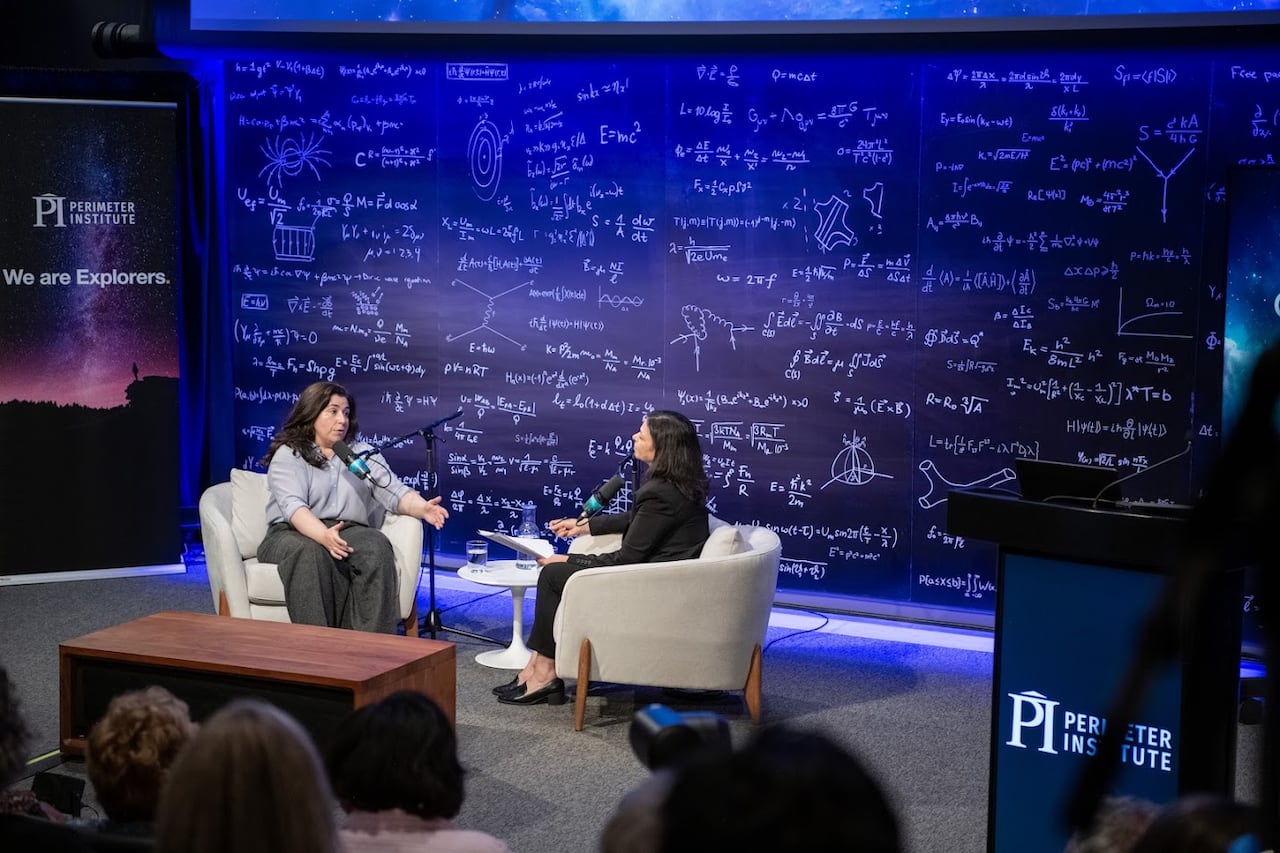
Arvanitaki, left, discussing her journey as a physicist with Ideas host Nahlah Ayed, emphasizing the significance of curiosity-driven research and the influence of AI in science. (Gabriela Secara/Perimeter Institute)
If we focus too heavily on potential applications — on the end goal — we risk missing out on revolutionary technologies. Therefore, no amount of money can purchase genuinely transformative advancements, as these stem from a profound understanding of the subject matter. And this true comprehension often entails navigating moments of uncertainty.
Do you think there’s a risk that with AI, we might lose our ability to gain insight, experience wonder, and maintain our curiosity when we have such advanced tools at our fingertips?
No, I don’t believe that will happen.
Reflecting on ancient history, one of my ancestors, Socrates [laughs] — once claimed that writing was the worst development for humanity. He argued it was detrimental to mental faculties because people would forget things and fail to exercise their minds.
-
Chemist who revolutionized energy storage awarded Canada’s top science accolade
-
Canadian astronaut Joshua Kutryk completes his first spacewalk
However, when you consider it, writing and language have been our most potent tools for preserving knowledge across generations. This has enabled us to build upon the achievements of our predecessors. This is my perspective.
We are currently undergoing a technological revolution that is reshaping our processes. We will adapt to these changes. I truly believe that this will redefine what we deem important. AI excels at performing calculations, so we won’t waste time on them, which I personally dislike. Nevertheless, the value of ideas remains crucial.
Tag: rewrite-pending