

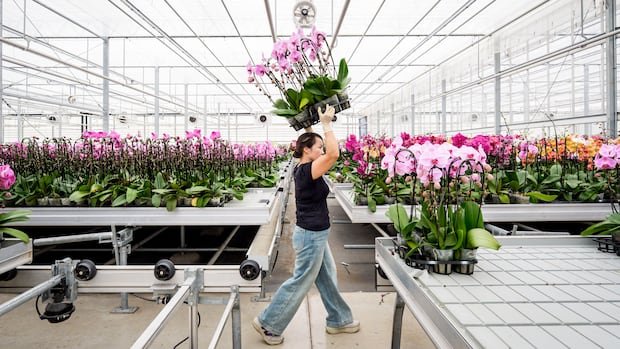

A fresh set of U.S. tariffs is looming over Canadian enterprises in the absence of a Canada-U.S. trade agreement. The potential impact stems from Section 338 of the Smoot-Hawley Tariff Act, which could influence up to $20 billion US worth of Canadian goods, including electronics, furniture, and orchids.
CBC photographer Evan Mitsui recently engaged with a greenhouse specializing in orchids and a furniture manufacturer in Ontario. Guann Chen, a third-generation orchid farmer operating a state-of-the-art greenhouse complex in St. Catharines, Ont., expressed concerns about the situation. His Orchid Greens products are distributed in major grocery chains like Loblaws, T&T, and Metro, as well as numerous nurseries and flower shops across Ontario, with a significant portion destined for the U.S. market.
Chen emphasized the crucial role of proximity to the U.S. border for perishable goods like orchids, allowing the Niagara region to leverage decades of greenhouse expertise into a lucrative export industry. Despite larger orchid operations in California, Chen emphasized the challenge of quickly shifting suppliers due to the long growth cycle of orchids.
Meanwhile, Lind Furniture, a long-standing upholstered furniture manufacturer based in Woodbridge, Ont., faces uncertainty amid the tariff threats. With a history of supplying major Canadian department stores and currently white-labeling for Costco, the company heavily relies on cross-border trade with small and medium-scale retailers in the U.S.
Michael Saifer, the general manager with nearly three decades of experience at Lind Furniture, highlighted the detrimental impact of uncertainty on their operations. The company has already felt the effects, leading to staff furloughs and production setbacks. Rising costs of components like steel fasteners and quality hardwoods further compound the challenges faced by the furniture maker.
The situation has forced the company to halt orders as clients require reliable supply chains, especially with the risk of border delays and additional taxes. Saifer lamented the constraints imposed by the uncertain trade environment, emphasizing the adverse effects on both the business and its workforce.