

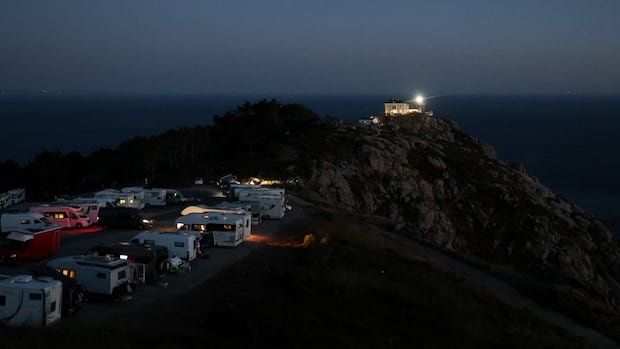

Hundreds of thousands of tourists have flocked to Spain to witness Wednesday’s solar eclipse. However, the event coincides with high temperatures and an increased wildfire risk in Spain, prompting concerns among authorities to prevent any fire-related incidents during the surge in astrotourism.
Virginia Barcones, the secretary general for civil protection and emergencies at Spain’s Interior Ministry, emphasized the need to be cautious due to the ongoing severe wildfire season in Spain. With over 603,000 acres of land already burnt in nearly 400 fires this year, the situation remains critical.
To prevent additional fires, authorities are mobilizing 35,000 officers to monitor large outdoor gatherings on Wednesday. Spain is a prime location for viewing the solar eclipse, with the path of totality spanning across several countries, including northern Spain and the Balearic Islands.
Only areas within the path of totality will witness the complete coverage of the sun by the moon. As excitement builds for this rare event, authorities are reminding the public to use proper eye protection, especially in Canada, where a partial eclipse will be visible.
Special measures have been put in place for the solar eclipse, anticipating a significant economic boost for Spain. A total of 660 official viewing sites have been designated to accommodate the expected influx of over 440,000 people, with an estimated 1.5 million individuals potentially traveling to witness the eclipse.
Despite the wildfire risks and scorching temperatures forecasted, eclipse enthusiasts remain undeterred. The eclipse, expected to contribute millions to Spain’s economy, is part of a series of solar eclipses to be visible from the country in the coming years, attracting more astrotourism interest.
With the 2026 eclipse marking the beginning of this celestial trilogy, the next eclipses in 2027 and 2028 are anticipated to further boost astrotourism, offering unique experiences for travelers to witness these extraordinary astronomical events in various regions around the world.