

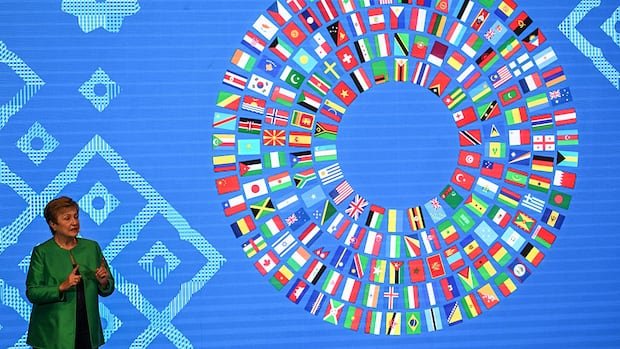

The International Monetary Fund (IMF) has revised its global economic forecast, anticipating a 3.1 per cent growth rate for this year, a slight improvement from its previous projection of three per cent in July and below the 3.5 per cent expansion seen in 2025. The IMF’s latest Economic Outlook indicates that the global economy is expected to bounce back to 3.4 per cent growth in 2027. The report, unveiled during the fall meetings of the IMF and World Bank in Bangkok, highlights that the United States is set to maintain a steady growth rate of 2.3 per cent in both 2026 and 2027.
Advanced economies collectively are projected to grow by 2.1 per cent this year, up from two per cent in 2025, before decelerating to 1.9 per cent growth in the following year. The IMF’s forecasts are grounded on an estimated 41 per cent rise in oil prices this year, averaging $96 US per barrel. Global inflation is anticipated to reach 4.7 per cent in 2026, with a predicted decline to 4.1 per cent next year.
The projections hinge on assumptions that oil and gas shipments via the Strait of Hormuz will resume by March and that the surge in artificial intelligence (AI) demand will moderate. IMF economists caution that while the AI boom is offsetting the adverse effects of soaring oil and gas prices, it introduces its own set of risks. Notably, the report underscores that AI benefits are not evenly distributed, with the United States and China accounting for over three-quarters of the net import demand for AI-related equipment.
According to Silvana Tenreyro, the IMF’s research director, the outlook is characterized by significant disparities, with 32 countries driving 95 per cent of global growth, compared to 54 countries in April. The report emphasizes that global growth reallocation is influenced by the war-induced supply shock and the strength of AI-related demand, rather than a simple acceleration or deceleration of growth.
Athanasios Vamvakidis, deputy director at the IMF’s monetary and capital markets department, highlights the potential risks associated with AI-related stock market corrections, rising bond yields, and cyber threats. Concerns over AI’s impact on employment are also raised, with IMF managing director Kristalina Georgieva describing it as a “slow-moving tsunami.” The IMF urges countries to enhance their national finances and address mounting debt levels, particularly crucial in times of high borrowing costs.
While some countries insulated from energy shocks and benefiting from AI adoption are maintaining growth momentum, developing economies and vulnerable emerging markets are expected to experience a slowdown. The Middle East and Central Asia are projected to witness economic contraction this year, with a rebound to 6.3 per cent growth in 2027. Eurozone countries are forecasted to grow by a modest 1.1 per cent this year and 1.2 per cent in 2027.
China’s economy is expected to expand by 4.5 per cent this year, slightly lower than the five per cent growth in 2025, aligning with the government’s official target. India remains on track to be the fastest-growing major economy, with a projected growth rate of seven per cent, a decrease from 7.7 per cent in the previous year.
The IMF, a global lending institution with 191 member nations, aims to foster economic growth, financial stability, and poverty reduction. During the Bangkok meetings, finance ministers and central bank governors are convening to evaluate the global economic landscape and deliberate on strategies to bolster financial stability and sustainable growth.