

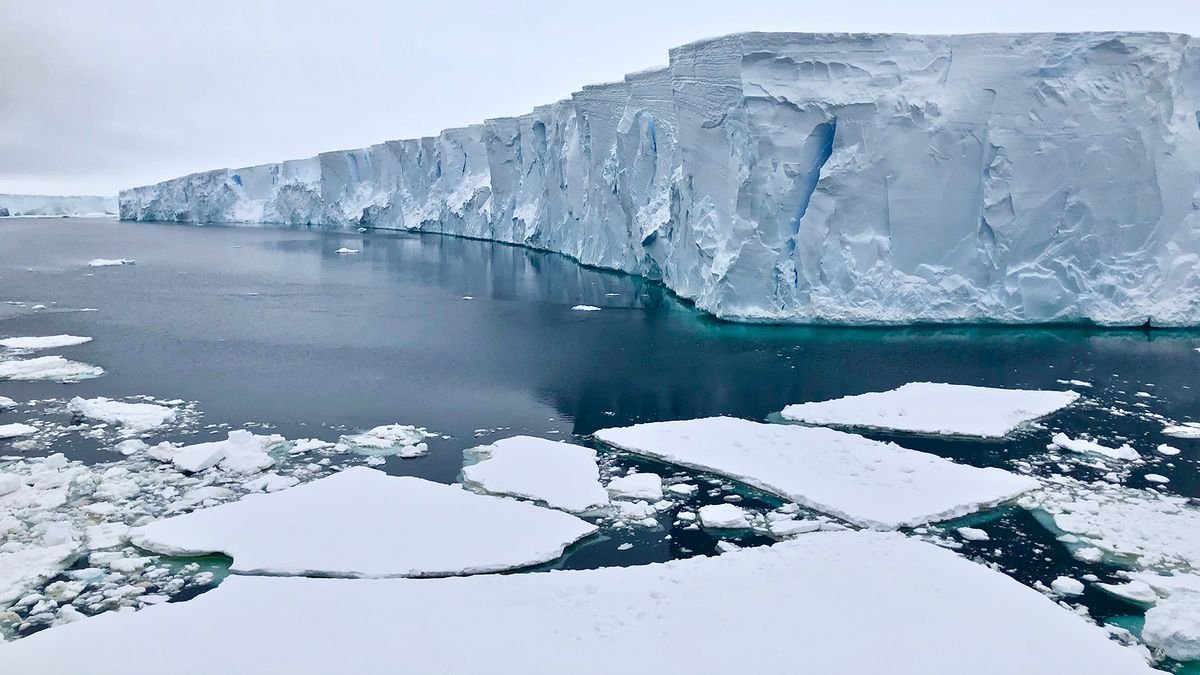

A massive ice sheet, commonly referred to as the ‘Doomsday Glacier’ due to its potential catastrophic consequences for human civilization, is teetering on the brink of collapse.
Recent years have witnessed cracks in the ice shelf of Thwaite’s Glacier in Antarctica, leading to what scientists describe as an ‘accelerated destabilization.’ A new study indicates that storm-like formations hidden beneath the glacier’s surface may be hastening its deterioration.
Researchers have observed rapid swirling vortexes in the water layer beneath the glacier, drawing in warm sea currents that cause the ice sheet above to melt and develop fractures. This melting exacerbates turbulence, initiating a destructive cycle that further harms the glacier.
In a study published in the journal Nature Geoscience, scientists noted that underwater storms melting the ice shelf from below explain significant changes in Thwaite’s Glacier, which has lost more than 600 billion tonnes of ice since the 1980s.
Lead author Mattia Poinelli, a glaciologist at the University of California, Irvine, cautioned that as global ocean temperatures rise, this phenomenon is likely to occur in other parts of Antarctica. She warned of the energetic vortices resembling storms, with strong vertical and turbulent motions near the surface.
Thwaites Glacier, located within the West Antarctic Ice Sheet, spans approximately 75 miles in width and covers about 74,000 square miles, similar in size to mainland Britain or the U.S. state of Florida. Known as “the Doomsday Glacier” among climate experts, its collapse would significantly impact global sea levels.
Should Thwaites Glacier disintegrate and melt into the ocean, sea levels could rise by one to two meters (three to six feet), posing a threat to major cities worldwide, including London, New York, Amsterdam, Bangkok, and Mumbai. Low-lying islands like the Maldives, Kiribati, Tuvalu, Polynesia, and Micronesia would face extinction.
Scientists have cautioned that the ice shelf beneath the glacier might collapse within the next decade, as satellite data reveals an escalating rate of fractures within the Thwaites Eastern Ice Shelf since the early 2000s.
Last year, glaciologist John Moore proposed the installation of a physical barrier on the seafloor to impede warm ocean water from further harming the glacier. However, his idea was met with criticism from over 40 researchers who argued that efforts should concentrate on reducing carbon emissions and mitigating global warming.