

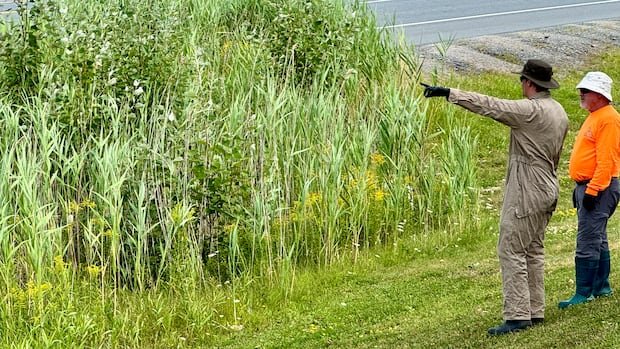

An unwelcome plant species is spreading further into northern Ontario, prompting local communities to take action to detect and manage it before it establishes a stronghold. The Junction Creek Stewardship Committee, based in Sudbury, organized a workshop in collaboration with the Invasive Phragmites Control Centre to educate individuals on identifying the invasive phragmites and preventing its proliferation.
Invasive phragmites, also known as common reed, have the potential to form dense clusters that displace native vegetation and disrupt the balance of wetland ecosystems. According to Jayden McGleish, a field supervisor at the Invasive Phragmites Control Centre, these plants have been observed encroaching into northern Ontario, with significant patches emerging even in Sudbury.
The invasive phragmites can outcompete native flora like cattails and bulrushes, creating obstacles for wildlife movement. McGleish highlighted the challenges faced by turtles and frogs navigating through dense phragmites patches, leading to adverse impacts on the natural habitat. Moreover, the plant’s growth along roads and through asphalt poses financial burdens on municipalities due to drainage issues and road damage.
Although the invasive plant is more prevalent in southern Ontario, it is increasingly encroaching on northern regions, including cities like Sudbury, Sault Ste. Marie, Timmins, and Thunder Bay. Erik Barr, working with Conservation Sudbury, emphasized the importance of proactive measures in controlling the spread of invasive phragmites before it becomes uncontrollable.
To distinguish between invasive and native phragmites, it is crucial to note that not all phragmites plants are invasive. The native variety in northern Ontario typically grows interspersed with other plants, unlike the invasive type that forms dense patches. Barr explained that invasive phragmites exhibit wider leaves, thicker stems, and a distinctive thin brown line where the leaf meets the stem.
Educating the public on recognizing the differences between native and invasive phragmites is essential for effective monitoring and management. Jaclyn Groom from the Junction Creek Stewardship Committee highlighted the need for increased awareness, particularly along roadways and railways where plant material can spread through human activities.
In terms of treatment, Chuck Simpson from the Invasive Phragmites Control Centre mentioned that Sudbury’s situation is relatively manageable due to the presence of native phragmites. The workshop demonstrated the use of backpack sprayers and an herbicide called Timberline for treating invasive phragmites, aiming for a significant kill rate to mitigate their spread.
Overall, raising awareness, early detection, and appropriate treatment methods are key strategies in combating the encroachment of invasive phragmites in northern Ontario.