

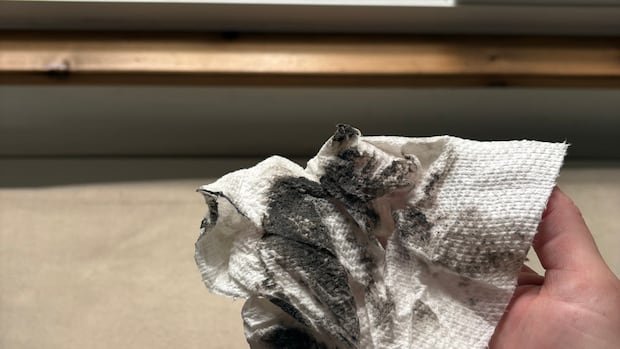

A group of researchers in Hamilton has uncovered insights about the black residue settling on neighborhoods near the city’s industrial zone. Residents have long been troubled by a dirty, dark substance coating their properties. The recurring issue resurfaced in early July, with some residents experiencing what they described as the most severe fallout in recent memory.
Sarah Styler, an associate professor specializing in environmental chemistry at McMaster University, along with Grace Yao, a PhD candidate in Styler’s laboratory, are part of the research project titled “What’s the Grime?” The study aimed to address the fundamental question of the nature of the residue.
By collaborating with volunteers to gather samples across the city in 2024 and 2025, the researchers discovered that the soot contains harmful chemicals consistent with coal combustion. Additionally, they observed higher levels of dust and polycyclic aromatic hydrocarbons (PAHs) near the industrial area in northeast Hamilton.
Styler collaborated with Environment Hamilton on this project, which was supported by a $15,000 grant awarded by the university in 2024. Living in east Hamilton, Styler has firsthand experience with the soot issue, as does Yao in Corktown.
The research team utilized sampling kits to collect residue from the homes of 50 volunteers throughout the city. Samples were taken from each kit at four-month intervals for analysis. The team noted that more dust falls closer to the industrial sector, and there is a higher presence of toxic compounds in proximity to the industrial area.
An update posted by the team on the Environment Hamilton website highlighted that PAH levels were elevated during winter compared to summer. While the study focused on 13 different PAHs, Styler indicated that other toxic substances might also be present in the residue.
Although the study could not conclusively identify the industrial sources generating the PAHs, Styler mentioned that with increased monitoring and analytical capabilities, such determinations could be made. The findings, as Styler noted, are likely unsurprising to residents living in the affected neighborhoods, as the substance appears to originate from industrial emissions.
Despite the community’s belief that the residue is an industrial byproduct, official sources have been perceived as lacking in providing sufficient information. The Ministry of the Environment, Conservation and Parks mentioned ongoing testing to identify potential sources of the residue in Hamilton’s north end.
Styler emphasized the importance of acknowledging that the research findings validate the community’s long-standing concerns about the industrial nature of the residue. The team plans to present their results at a community meeting on August 20 and aims to expand the study to include 200 volunteers, explore additional compounds in the residue, and investigate effective cleaning methods.