

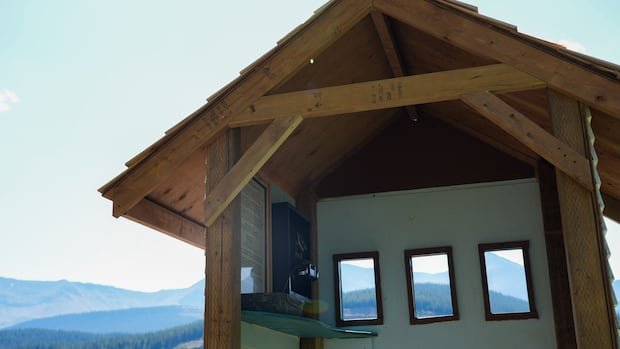

Andy McCracken, a septuagenarian, hesitates before dialing his late father’s phone number on a vintage rotary telephone one sunny day in July. Speaking into the disconnected landline inside a small wooden structure next to a graveyard in the Rocky Mountain foothills of Alberta, he utilizes a “wind phone” to converse with the departed. This symbolic phone allows visitors to have one-way conversations with deceased loved ones.
Positioned at Mountain Park Cemetery in Yellowhead County, the highest elevation cemetery in Canada, the wind phone sits close to 1,900 meters above sea level, making it the highest in North America. Installed by Yellowhead County at the end of July, the wind phone provides a unique connection to the past for individuals like Andy McCracken and his wife Anne, who plan to have their ashes interred at Mountain Park when the time comes.
Mountain Park, established in 1911 as the terminus of the Grand Trunk Pacific Railway line, was a bustling community until the closure of the coal mine in 1950. Now a ghost town enveloped by nature, the former mining town once boasted around 1,000 residents residing in 100 homes. Today, only the cemetery remains, housing 269 documented interments dating back to 1913.
During an interview at the cemetery, Madison Sharman, heritage co-ordinator for Yellowhead County, highlighted the town’s reliance on the railway for connection to the outside world. She recounted how the train tracks split off in a distinctive “Y” shape, now obscured by vegetation, underscoring the town’s dependence on the railway for supplies and social interaction.
Despite the allure of a secluded life in the subalpine, Mountain Park Cemetery tells a tale of frontier challenges and tragedy. With infant burial sites and graves from the Spanish flu pandemic, the cemetery reflects the hardships faced by the early residents. Mining accidents also left a mark on the community, with 17 known deaths attributed to worksite mishaps and health hazards.
Remnants of the former town have faded over time, but efforts led by volunteers, including Mary Salzsauler and the McCrackens, have restored the cemetery. The serene setting of the cemetery, set against the backdrop of Cheviot Mountain, offers a sense of peace and reflection on the town’s history and the lives of those laid to rest.
As Mountain Park Cemetery transitions into the care of Yellowhead County, the legacy of those interred there continues to be honored. New cremation burials for individuals with ties to the area are managed by the county, ensuring that the stories of those who once called Mountain Park home endure for generations to come.